If you are from Generation X, you likely remember a childhood filled with scraped knees, muddy shoes, and being called home only when the streetlights flickered on. Outdoor play wasn’t a scheduled activity—it was childhood itself. With limited toys and endless imagination, we learned creativity, independence, and resilience simply by being outside.
Today, childhood looks very different. Screens are everywhere, schedules are full, and adults (with the best intentions) often prioritize cleanliness, safety, and structure. But research and experience continue to tell us the same thing: children learn best when they are free to explore, experiment, and yes… get messy.
Why Outdoor Play Matters More Than Ever
Outdoor play supports every major area of early childhood development. When children run, climb, dig, and explore, they are strengthening:
- Gross motor skills through movement and coordination
- Fine motor skills are developed by scooping, pouring, and manipulating natural materials
- Social-emotional skills as they negotiate, collaborate, and problem-solve with peers
- Cognitive development through curiosity, experimentation, and cause-and-effect learning
Outdoor environments naturally invite creativity and risk-taking in developmentally appropriate ways, something indoor spaces simply cannot replicate.
Mud: A Gateway to Learning
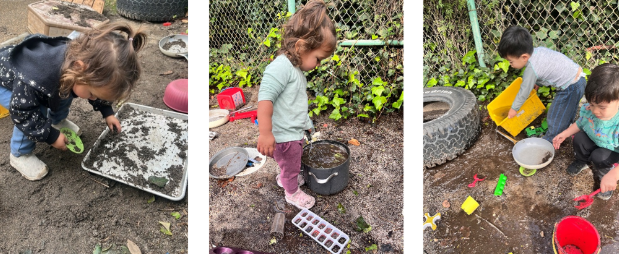
Mud may seem simple, but it is one of the richest learning tools available to young children. Creating outdoor mud spaces encourages children to ask questions and test ideas:
- Does mud float or sink?
- What happens when mud dries in the sun?
- How many scoops does it take to fill a bucket?
These moments are the building blocks of scientific thinking, early math concepts, and critical reasoning. Children aren’t just playing; they are forming hypotheses, testing outcomes, and learning through experience.
Sensory Play That Builds the Brain
Think back to the first time you felt sand between your toes. Now imagine the sensory experience of sinking bare feet into cool, squishy mud. Sensory-rich play like this helps children:
- Regulate emotions
- Improve focus and attention
- Strengthen neural connections
- Develop body awareness
Studies show that messy outdoor play can be both calming and restorative, especially for young children who are still learning how to manage big feelings.
Building a Connection to Nature and Each Other
Messy outdoor play fosters more than physical development. It helps children build a lifelong connection to nature while developing essential skills such as:
- Cooperation and communication
- Problem-solving and creativity
- Early literacy and math through play-based experiences
When children explore together, they learn empathy, patience, and teamwork – skills that extend far beyond the classroom.
Why Do We Resist the Mess?
When we pause to reflect, it’s often hard to find a strong reason for avoiding dirt, mud, or bare feet. Mess washes away. Shoes can be cleaned. But the developmental benefits of unstructured, outdoor play last a lifetime.
Playing with dirt and water is not just fun; it is essential. By embracing messy play, we give children the freedom to explore, innovate, and grow into confident, capable learners.
So the next time your child comes home muddy, remember: today’s mess is tomorrow’s strength.
The information shared in this article is intended for general educational purposes only. Every child develops at their own pace, and individual needs, abilities, and sensitivities may vary. Outdoor and messy play should always be supervised and adapted to ensure a safe, supportive environment for each child.
Want to Learn More?
At the Institute for the Redesign of Learning, our Early Education program is thoughtfully designed to support whole-child development through play-based, research-informed learning experiences. From sensory exploration to social-emotional growth, we meet children where they are and help them thrive.
👉 Interested in learning more about our Early Education program or scheduling a tour? Contact our Director, Angela Barlow (abarlow@redesignlearning.org), to schedule a tour and see how purposeful play helps build confident, capable learners.